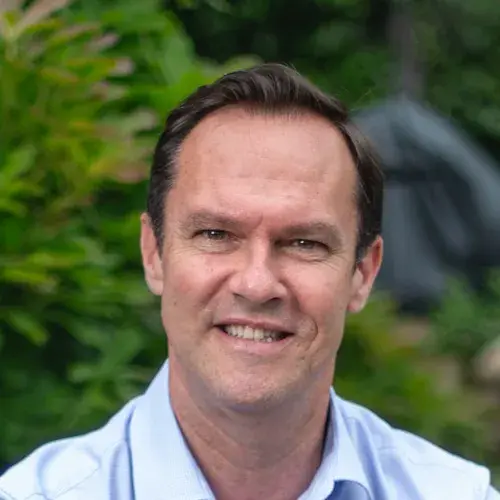
Daniel Gruber, Party President of the FDP Zug
«Now we can head into the election campaign with this.»
Daniel Gruber, President of the FDP.The Liberals of the Canton of Zug decided quickly last autumn. He wanted to know what the people of his canton thought as soon as possible before the end of the year - and with what he could campaign in 2026. BrainE4's online dialogue brought important insights.
What was your challenge?
I didn't feel that we had concrete problems. For me, it was clearly a recommendation from Dominik Reber of Hirzel.Neef.Schmid.Konsulenten, whom I value highly and have known for a long time. He has already supported me in two or three communicative situations, and if he feels that this will benefit us, then I take a closer look at such a recommendation.
You had already felt the pulse of the population before. How?

You talk to many people and get a good feel for the pulse. Of course, you also move in a certain "political bubble" in the process. That's why it's so exciting to see how strongly our population dialogue extends beyond this bubble.

At the same time, this is exactly the right circle - people who provide orientation and shape developments. These are the opinion leaders who decide in a small canton like Zug - about 20-30 personalities.

«This prioritization is very valuable.»
But around 700 people participated. That's certainly far beyond the circle of 20 opinion leaders you mentioned.
I think we had certain shifts in our hypotheses that we had initially formulated. But you can't put a gun to someone's head and say: "You must participate now." And let's be honest: politics isn't that interesting after all.
You can see this in other surveys, for example in the city of Zug for the "Sports Mile" with the new indoor swimming pool. Who participates there? Exactly those who are interested: the swimming clubs, the directly affected residents, etc. And then it's sold as a "broad spectrum of opinion," which of course is only part of the truth.
What benefit do you derive from the online dialogue with BrainE4?
The main benefit for the next election campaign are the statements that performed best in the ranking and that will make up the core message. This prioritization is very valuable.
Do you think the other parties noticed your online dialogue?
Absolutely sure. And in external perception, first and foremost, the professional execution counts. The left-wing parties won't vote for us anyway, but it left an impression on the center and the SVP. And with the result, i.e., with these statements that the others don't have, we can now head into the election campaign. Everyone knows that you don't get this for free. This has strengthened us. Especially these well-founded statements that our competitors don't know yet.
«It left an impression on the other parties.»
You're still holding back.
Yes. And it would also be too much for the public. Not everyone is interested in that. It was important for the party to show: "We take you seriously. We listen to you." That's something different from simply representing an ideology. Listening, responding to the individual, asking follow-up questions, and entering into dialogue is different from just "hearing"!

1/2
The preparation time for this online dialogue was a few weeks.
It was a "rush job." We wanted to present the results to the public on January 5th, before the traditional Epiphany meeting of the Center Party. We wanted to be there a day earlier. The intention behind it was right, but in hindsight, we should have given ourselves a little more time.
Have concrete decisions been made based on the insights?
We are revising our election campaign slogan and theme. We originally took terms from the report. But they sometimes seemed too factual and too dry - even though they were substantively correct. The online dialogue showed us: People don't want change at any price. The FDP stands for change and further development. But we must listen to the population. A lot is changing in the world right now - perhaps too much.
«People don't want change at any price.»
What conclusion do you draw?

For me, the 15-20 topics that we want to advocate for are central. Because they reflect liberal values and are still broad enough that candidates can choose topics that suit them or their municipality. A government councilor conducts their campaign differently in terms of content than a municipal councilor. And the executive functions differently than the legislative.

Someone who goes to the Officers' Society talks about different things than someone who goes to a nursing home. That's why it's also appropriate that our base also participated in this online dialogue.

How would that work if only FDP members were addressed?
That would give completely different results. You have to see how you group the people. We had 300 people from our 1,800 members who participated. Depending on where you direct the engagement efforts, you end up with a result. You have to be aware of that.
When people have a problem burning under their nails, then even more want to participate. In contrast, your content was more open, general, neutral: "What is the mood?"
True, that's a good observation. Suffering and controversies fuel such things.
What is your conclusion about the collaboration?
For me, it was a great experience, especially because of these top points in the ranking. We now have many points and arguments that are still very liberal, but each of our cantonal council candidates can pick two or three points from them that suit them. This way, we present the entire population of Zug with a bouquet full of ideas that also reflect our liberal compass.
Interview: thk
Facts:
7 open questions
421 participants
717 opinions and ideas
33,504 validations
2/2
BrainE4

Ready to redefine listening?